
Why Threats Work: The Neural Economics of Cooperation
The Folk Theorem rested for thirty years on an unexamined claim: that punishment threats stay credible. A four-layer chain closes the gap. Folk Theorem needs credible punishment. Credibility collapses the moment a game-end is visible. That moment is what the studio calls Loyalty (a time horizon)…

Why Threats Work: The Neural Economics of Cooperation
Finding Solved Games in Moving Castles.

A cooperation threat is simple. I will punish you if you defect. The moment that sentence hits the table in a negotiation, a game starts underneath it. If punishment is credible, I defect less because the threat pins me down. If punishment is not credible, I defect as much as I want because you cannot afford to carry it out. A credible threat pins cooperation in place. An uncredible threat is expensive talk, and I ignore it.
The Folk Theorem, the foundational result in repeated-game theory, rested on this for thirty years. It proved that in an infinitely repeated game, any individually rational outcome can be an equilibrium, sustained by punishment threats, as long as the shadow of the future is long enough. The shadow is the discount factor, the weight players give to future payoffs versus now. Long shadow means future payoffs matter. You threaten defection consequences severe enough to make defection not worth it today. The threat credibility rests on a hidden assumption: that the game is infinite, or at least long enough that you have the patience to follow through. The moment the shadow breaks, the moment a player sees the end in sight, the threat collapses.
This quarter, that hidden assumption surfaced. Not in a theory paper, but in three places: a neuroscience lab that measured the neural substrate of betrayal, a mechanism-design result that formalises when visible game-ends wreck cooperation, and our own design table, where the coordination mechanic for Cosmic Ascendency, an unlaunched 4X, was found to carry the same unexamined assumption about infinity that the Folk Theorem bundled into a parenthesis thirty years ago. We found it before anyone played it. That is the only reason this issue exists.
Here is the chain that closes it. Folk Theorem proves cooperation needs credible punishment. Punishment credibility rests on the shadow of the future, the discount factor applied to what happens next. The shadow collapses the moment a game-end is visible. A visible game-end is what the studio calls Loyalty, a time horizon you can see and count down against. And betrayal is not a loss, it is a neural event that bypasses loss aversion entirely, firing a distinct circuit so compulsive that punishment becomes automatic, not optional. That circuit is what makes the threat actually stick, and the moment the horizon ends, that circuit stops firing back. Threats work because betrayal is neurological, not rational. And the moment the game-end is visible, the neurology stops working.
The studio has skin in this, and it is worth being precise about which kind. Cosmic Ascendency's season-end auction window is a visible game-end: the season is the game, the window is the hard cutoff when trading stops and the game settles. It sits on the calendar from round one, countable by every player. The game has not launched. Nobody has played a round. What we have is the config, and a tool that reads it. The tool says the mechanism dies at round 7, one round before the window, because at that point the remaining shadow is 0.850 and the Folk Theorem needs 0.9. This issue's tool is that tool: it tells you where your cooperation mechanism is about to die because the game-end is about to become visible. We pointed it at ourselves first, and it found something. The prediction is published here, before the game ships, so that you can check it against us later.
Five from the wave. One sentence each. Cited, read through the mechanism.
- The Folk Theorem as the foundation: Fudenberg and Maskin (1986), "The Folk Theorem in Repeated Games with Discounting or with Incomplete Information," proves that in an infinitely repeated game, any individually rational outcome can be sustained as a perfect equilibrium via trigger-strategy punishment, as long as the discount factor is high enough (shadow of the future is long enough), which means the Folk Theorem assumes an infinite or indefinitely long game and does not address what happens when the endpoint becomes visible.
- The Shadow of the Future as the load-bearing assumption: Axelrod (1984), "The Evolution of Cooperation," empirically grounds iterated Prisoner's Dilemma and demonstrates that tit-for-tat succeeds when the shadow of the future is long enough for retaliation to be worth believing; Benoit and Krishna (1985) prove the complementary result, that the moment the endpoint becomes visible, cooperation unravels backward from it. Axelrod shows the indefinite-game success; the finite-game collapse is their theorem, not his.
- Finite-horizon collapse as a known failure mode: Benoit and Krishna (1985), "Finitely Repeated Games," show that finite repetition collapses cooperation to single-shot equilibria at game-end (the Backward Induction Problem), because players know the last round will be played with no threat of punishment, which unravels backwards through the game, making the Folk Theorem's infinite-game result irrelevant the moment the endpoint is visible.
- Betrayal Aversion as a distinct neural process: recent neuroscience (Aimone, Houser, and Weber, 2014, "Neural signatures of betrayal aversion: an fMRI study of trust," measuring anterior insula activation distinct from loss aversion; and Tang, Tan, Gao, Lin, Gan, Ding and Gao, 2026, "Betrayal is worse than loss during cooperation," bioRxiv 2026.03.04.709582, which dissociates the two: betrayal is encoded early in the decision, indexed by the P3, while loss aversion surfaces later in the LPP, and betrayal aversion suppresses cooperation more strongly than loss aversion does) identifies a neural substrate distinct from loss aversion or rational calculation, a circuit that activates specifically in response to betrayal and that drives punishment and cooperation enforcement with an automaticity that rational incentive structures alone do not produce.
- Studio case: Hyperwall's auction window as a visible game-end (design-time prediction, not play data): Cosmic Ascendency is pre-launch, so there are no players, no Season 1 and no observed defection; instead the linter, run against the Season 1 config (8 rounds, discount factor 0.85, a season-end auction visible from round 1, no rolling horizons), returns HORIZON-COLLAPSE-RISK with collapse predicted at round 7, remaining shadow 0.850 against the Folk Theorem threshold of 0.9, which is a falsifiable prediction published before the game ships (Cosmic Ascendency, 2026. Studio design analysis, not play data).
Shipping with this issue: The Horizon-Collapse Linter, built on Python standard library. Point it at any coordination mechanism with a time horizon, and it detects when that horizon becomes visible to players, then flags the Folk Theorem failure mode and recommends overlapping or rolling horizons to keep the shadow long. The full tool and its install sit below, after The Read.
The mechanism: when the game-end is visible, cooperation dies
The Folk Theorem is not a description of what happens. It is a theorem, a proof. It says: in an infinitely repeated game, you can sustain cooperation via threat, because the threat is credible. The credibility rests entirely on one thing: a player believes the game will continue long enough that punishment today is worse than honesty today. That belief is the shadow of the future, the discount factor applied to what comes next. The moment that shadow breaks, the threat loses credibility and cooperation stops being a rational choice.
Backward induction (Benoit and Krishna, 1985) shows exactly how. Start at the last round. In the last round, there is no future, no threat of punishment, no shadow. A rational player defects in the last round. Now move back to round n-1. In round n-1, you know that everyone will defect in round n no matter what you do, so your action now cannot change future payoffs. Why not defect now too. Move back again. By induction, cooperation unravels from the endpoint backward through the entire game, and a finite game collapses to single-round defection equilibrium, the same result as a one-shot game.
The Folk Theorem does not address this because the Folk Theorem assumes the game never ends. In an infinite game, there is no last round to start backward induction from. The shadow is infinite. Threats are always credible because future punishment is infinitely important relative to today's defection gain. The moment a game-end becomes visible, the shadow shrinks to a finite number of rounds, and cooperation collapses exactly as Benoit and Krishna predict.
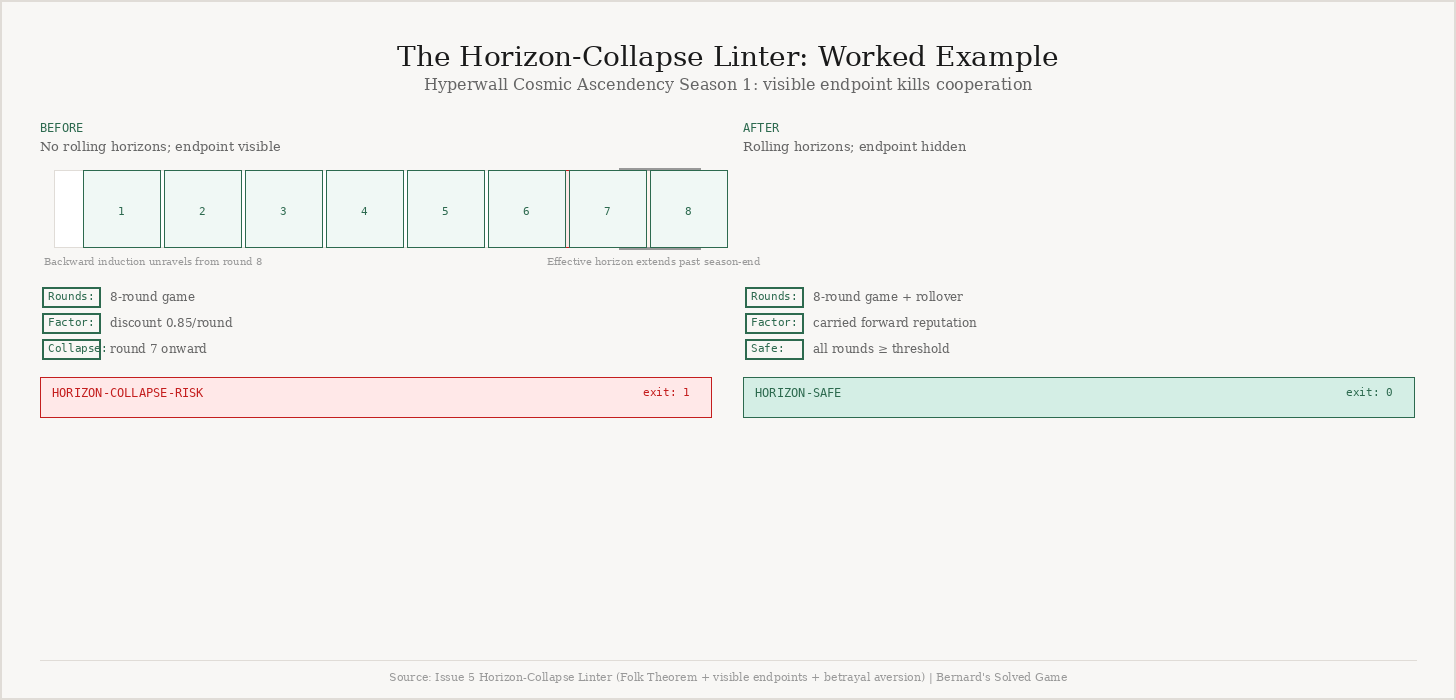
The studio's own case illustrates this, and it is worth being exact about what kind of case it is. Cosmic Ascendency has not launched. There is no Season 1, no players, no observed defection. What exists is a rulebook (eight rounds, discount factor 0.85, a season-end auction window visible from round one, no rolling horizons) and a tool that reads it.
Run the linter below on that config and it returns:
[RISK] season_end_auction (round 8)
  Collapse at round: 7
  Remaining shadow: 0.850
  At round 7, discount_factor^1 = 0.850; Folk Theorem requires >= 0.9

VERDICT: HORIZON-COLLAPSE-RISK
This is a prediction about a game nobody has played yet, derived from the game's own parameters. At round 7, with one round left, the shadow is 0.850 against a threshold of 0.9. Cooperation is predicted to unravel backward from round 8, not because players are wicked, but because the season-end auction window was announced at the start, visible to all, and the final rounds are therefore finite. The discount factor for a round-8 payoff collapses, because nothing carries forward to a season that does not yet exist. The threat "I will retaliate next round" stops being a threat in round 8 if there is no round 9.
We publish the prediction before the game ships, so that when it ships you can check whether we were right. That is the only version of this claim we are entitled to make.
The fix is not to hide the endpoint. The fix is to break the endpoint into overlapping or rolling horizons. A season that is eight rounds but carries reputation and alliance relationships that extend past the season-end into the next season has a longer effective discount factor than the calendar suggests. The visible endpoint of season 1 is not the same as the visible endpoint of the game if season 2 is already trading and reputation matters. You make the horizon roll, and the threat credibility stays.
That is the entire mechanism. Visible game-end, finite shadow, cooperation collapse, backward induction unravels from the endpoint. Fix by extending the effective horizon past the visible endpoint.
The Folk Theorem assumed infinity was obvious. Hyperwall's auction window made infinity a line on a calendar.

The Horizon-Collapse Linter
Bernard-layered. Anchored on Instructor (~13k stars, MIT): point it at a prose rulebook with --from-rulebook and Instructor returns a Pydantic-validated GameConfig, which the linter then reads. The default JSON path is stdlib-only, offline, and imports nothing.
The Read built the argument. The linter is the argument made executable: point it at your game's time structure (seasons, rounds, auction windows, vesting schedules, agent task loops, any coordination mechanic with a visible end) and it enumerates the horizons, flags which ones are about to become finite and visible to rational agents, and recommends rolling or overlapping structures to keep the shadow credible. The full source and how to run it sit below.
Founder offer
The free tier carries the Tape and the Read in full, every week, including the mechanism and the studio's own failure case above. The linter's full source, the Brief, and the Feed sit behind the paywall, which is where the studio discloses its running costs honestly. Pro is $15 / mo or $250 / yr. Founder is $300 / yr, capped at one hundred seats, and the founders-only MCP server goes live once all one hundred are taken. If you ship a game or a coordination mechanism with a visible horizon, the linter pays for itself before the first player sees the endpoint. No pitch beyond that. The mechanism is the argument.